
RECOVERY BIOACTIVE COMPOUNDS FROM GRAPE RESIDUE OF PERUVIAN AMAZON USING GREEN TECHNOLOGY
Detalhes
- Tipo de apresentação: Pôster
- Eixo temático: Engenharia de Processos e Tecnologias Emergentes (ET)
- Palavras chaves: Supercritical fluids; Microwave; anthocyanins;
- 1 Facultad de Ingeniería Agroindustrial / Universidad Nacional de San Martín
- 2 Facultad de Ingeniería Agroindustrial / Universidad Nacional de San Martin
- 3 Escuela Profesional de Ingeniería Agroindustrial / Universidad Nacional Autónoma de Chota
RECOVERY BIOACTIVE COMPOUNDS FROM GRAPE RESIDUE OF PERUVIAN AMAZON USING GREEN TECHNOLOGY
José Luis Pasquel Reátegui
Facultad de Ingeniería Agroindustrial / Universidad Nacional de San Martín
Resumo
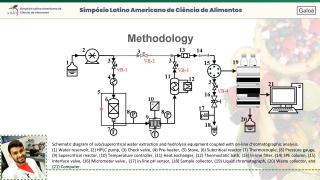
Agroindustrial fruit residues are rich sources of natural antioxidants. The grape residue presents high content of phenolic compounds such as anthocyanins, phenolic acids, catechins, and stilbenes, which have health-promoting properties. In this sense, special attention is being focused on the extraction of bioactive compounds from this bio-product. Extracts with a high content of bioactive compounds were recovered from the grape residue (Vitis labrusca) native to the Peruvian Amazon, using two techniques: Supercritical Fluid Extraction (SFE) and Microwave-Assisted Extraction (MAE). Separation and quantification were done by UHPLC-Fluorescence. Fourteen anthocyanins were identified, with Malvidin 3-glucoside being the major compound. In addition, analysis of phenolic content, antioxidant capacity (ABTS and DPPH), and monomeric anthocyanins were performed. The variables controlled by the SFE were temperature (41-45-55-65-69 °C) and pressure (10-13-18-23-25 MPa). CO2 and co-solvent (Ethanol) flows were fixed at 2 mL/min and 1 ml/min, respectively. In the MAE, the study variables were methanol concentration (25%, 50%, and 75%), temperature (50, 75, and 100 °C), and power (200, 500, and 800 W). As expected, the highest yield (15.79 %) was observed by the SFE technique at 55 °C and 25 MPa. Furthermore, the concentration of phenolics, monomeric anthocyanins, and antioxidant capacity was higher in the extracts obtained by SFE due to the SFE selectivity and the use of ethanol, which modified the polarity and density of the solvent, improving the extraction yield.
Discussões Científicas de Qualidade
Com ~200 mil publicações revisadas por pesquisadores do mundo todo, o Galoá impulsiona cientistas na descoberta de pesquisas de ponta por meio de nossa plataforma indexada.
Confira nossos produtos e como podemos ajudá-lo a dar mais alcance para sua pesquisa:
